now every web marketer knows that each page of a website should target a well-chosen and researched keyword phrase (whether or not they follow through on this strategy!). But many people skip the keyword research step entirely when it comes to blogging. It's a wasted opportunity, because keyword-optimized blog posts can help you both now and later:
Blog posts allow you to target hot, trending topics that wouldn't be worth devoting permanent site content to. You can capture search traffic while that keyword phrase is popular, and let the post get buried in your blog archives once the trend is over.
Blog posts, especially how-to articles, make great evergreen content that not only ranks quickly but can continue to rank well and pull in traffic for months and years to come.
Here are just a few examples of keyword-targeted blog posts:
Recipes: If you have a food blog, do a little research before titling and publishing your posts. People look for recipes online all the time. For example, a couple of days ago I was looking for a specific tomato sauce recipe made with butter and an onion. Googling "tomato sauce with butter onion" returns a number of results with those keywords in the title.
Evergreen how-to: An example from our own blog – Ken's 2009 post on how to find anyone's personal email address continues to pull in lots of traffic by appealing to the stalker in all of us. This kind of post could apply to endless niches (how to clean leather, how to find a good contractor, how to edit a long manuscript ...).
Timely hot topic: During the World Cup a lot of people were conducting searches about vuvuzelas. Some folks took advantage of this with posts on how to filter the vuvuzela noise or where to buy vuvuzelas. Keep an eye on topics you can capitalize on in this way.
Here's an easy three-step process for targeting keywords with blog content.
Step 1: Identify Keyword Opportunities
Before you can target anything, you need to determine what keyword phrases are likely to bring in relevant traffic. The kind of research you do will depend on your goals for the post.
If you're chasing a timely topic – Use Google Trends or Google Suggest to find keyword phrases. Traditional keyword tools can also be of some use here—our Free Keyword Tool, for example (shameless plug) pulls in fresh data so you can research current events sooner.
If you're chasing recurring traffic – We've said it before, we'll say it again: The best way to find keywords that are relevant to your audience over the long term is by consulting your own analytic data. Specifically, look for keywords—and, more importantly, groups of related keywords—that are driving traffic and/or conversions, but for which you don't already have a dedicated page. For example, if people are finding your food blog with the keyword "guacamole," but you don't have a post dedicated to this happy ending for avocados, write one! A post with that keyword phrase in the title tag will not only rank higher for those searches, it will be more obviously relevant, increasing click-through.
Step 2: Narrow Down Your Topic
As a topic, "guacamole" is a bit broad. You're extremely unlikely to rank on the first page for that keyword. You'll need to pick a narrower topic that will still appeal to a good number of readers. If you use keyword grouping software, like WordStream for SEO (shameless plug), you can quickly find a variation that is both specific and relevant. Otherwise, use a keyword tool—and your best judgment—to determine a suitable phrase.
If you have a Flip camera at your disposal, you might decide that "video of how to make guacamole" is a good choice. This is much more specific, and you could make it even more specific if you chose ("video of how to make guacamole from scratch," "video of how to make the best fresh guacamole," etc.).
Step 3: Write and Optimize Your Post
I always feel like choosing your topic is the hard part of blogging—once you know what you want to write about, the actual writing is easy! (I realize not everyone feels this way.)
Here are some tips to keep in mind when writing your keyword-targeted post:
As mentioned above, don't forget to use your keyword in the title tag. It's a key signal for search engines.
Even if you're doing a video post, you'll want some text on the page (in this case, the recipe). Use your keyword, and relevant variations on your keyword, in the text.
Use the keyword in appropriate meta tags, such as the meta description and the file name and alt text of your images. Also use it in the title and description of your video.
Use internal linking to your advantage. For example, if you have an index page of videos and another of dip recipes, add a link to the video from both, with optimized anchor text.
Don't forget to promote your post—on Twitter, Facebook, etc. This encourages external linking as well.
Now, that wasn't so hard, was it? In fact, targeting keywords with blog posts is rather easier than doing so with web pages, since you don't have to worry about how they fit into your site architecture. (In addition, promotion is often more natural.) And keyword research is as good a way as any to come up with topics to blog about.
10 + Ways to Find Someone's Personal Email Address
Initially just give me someone's name, and I'll find their personal email address. Sure, it may take some extensive digging and sleuthing, but I'll find you eventually. And I'm not paying to root you out or buying your private info from a lead gen company (though sometimes that would be easier). This is just good old fashioned, organic searching, scanning and scouring the Internet like a Web gumshoe.
How to find someone's email address details:
Google Name + "Email"
Google Name + Place of Work
Check their personal blog
Try some "kitchen sink" queries
Search LinkedIn
Search their company website
Message via Twitter or LinkedIn
Check Whois
Use Google's site search operator
Use advanced Google search operators
Check social media profiles
Check people search sites
We'll look at each of these methods in a little more detail, but first:
Why is it important to use someone's personal email address?
If you're sending out an important email that you really want to be taken seriously and improve your chances of getting an actual response, you need to go directly to the source. Sending an important, personal email to the info[@]companyX.com, or dumping it into a "Contact Us" form is a virtual black hole.
This is especially true if you're trying to get in touch with someone you don't know or you've never contacted before. Primary examples of this include:
Applying for a job
Any form of outreach, like a link request, interview request for your blog, if you're seeking media coverage for a story, etc.
What's more, by taking this extra step and getting directly to the source, you show real initiative and will distinguish yourself from the candidates applying for that same job or requesting that same link.
12 Tips and Tricks to Find Anyone's Email Address
Now, when I say "personal" email address, I'm not talking about a Gmail, Hotmail or AOL account exclusively. I'm also referring to their personal company email address, Web hosting domain email, blogger mail account, or any Web property email address I can find. Because of the depth and breadth and ubiquity of content sources on the Web, you can find contact information for pretty much anyone who has an email address, even if they don't actively promote it on their website. All you have to do is search and keep refining your searches until you strike pay dirt.
Let the Hunt Begin
1) Basic Name Queries by Googling Emails
You can start your sleuthing by running a generic search query for someone's name. But understand that this approach probably won't get you very far, unless the person you're seeking has a unique name, like say Jets WR Jerricho Cotchery. However, if that person's name is at all common, you'll need to add some distinguishing modifiers. Think of it as engaging in the long tail of name searching.
Some initial modifiers you should incorporate to narrow and refine your search are:
[name] + email (or) email address
[name] + contact (or) contact information (or) contact me
2) Name Queries with Personal Modifiers
Now, if that doesn't work, get even more granular and add any personal information you may have already or uncovered about this person in your initial search, such as:
[name] + "home town"
[name] + "company they work for"
You can even mix and match all the above modifiers. If you succeed here, terrific. Mission accomplished. But all too often, this is only the initial stage of your research, as this method yields results less than 10 % of the time. To really find who you're looking for, you'll need to go corporate.
Hunting for Company Email Addresses
3) Business Networking Search Queries
One of the best resources for finding direct contact information is through a company email network. Anyone working for an organization has an in-house email. Now, typically if you're searching for someone's direct email for a job interview, link outreach or media coverage, you likely know where they work or conduct business already. But if you're still in the dark, ZoomInfo and LinkedIn are pretty fertile grounds for harvesting personal information.
You can either search the websites internal engine or run queries in Google, like so:
[name] + LinkedIn
[name] + ZoomInfo
Notice the quick success I had with a probe of ZoomInfo.
4) Basic Company Name Queries
Now, once you get a place of business from their profile, you should visit the company website and start running queries, using the person's name in the hope that you'll find any indexed document with their email address. Most times, generic name searches yield citations (like so-and-so pitched a gem for the company softball team), not actual email addresses. So again, get more specific with modifiers.
[name] + email
[name] + contact
Adding these modifiers will really boost your chances of finding your target.
5) Basic Company Search Operators
However, if you're still coming up short, you'll need to roll up your sleeves. This is when I break out my super-sleuth hat and get creative with Google search operators. In the majority of cases, Google information retrieval yields more results than a company's internal search. If you're not familiar with search operators, read this.
So what you'll do now is search Google, using the Google Search Operator Query "site:companywebsite.com" as your root and sprinkle in modifiers, like so:
site:companywebsite.com + [name] + email
site:companywebsite.com + [name] + contact
6) Advanced Company Search Operators
Pretty much every organization has a unique, yet uniform company email addresses structure, which you can leverage in your search efforts, using advanced search operators. For example, at WordStream our email structure is “first initial + lastname@wordstream.com." But since each company has their own format, you'll need to play around with a host of possible email address structures using the root search operator.
Note: Use the standard format here "@," I'm using [at] so as not to activate hyperlinks.
It's important to mention here that the information you're seeking with these queries will be bolded in the meta tags text snippets, like so:
An example search engine results page (SERP) with results displayed for site-search operation results
I'd say this method yeilds results 80% of the time for me.
7) Random Kitchen Sink Queries
However, if you're still coming up short, you can drop the company search operator root and pound away with random combinations of the above suggestions. 99% of the time, this is very effective. For example, here's a random query I ran for a faculty member at Boston University (note: name is blurred for privacy):
Notice my query: "BU [person's name] @bu.edu." It's kind of nonsensical, but nevertheless this query combination succeeded where the other techniques failed, yielding this person's email address. Point being, at this stage, I throw everything at the wall to see what sticks.
Even More Options to Find an Email Address
8) Social Networking Profile Queries
Another avenue you can explore for personal information are social media profiles. I've had the most success with social sites like Twitter. And chances are that employing the original basic queries that I mentioned above will display if this person has a Twitter profile.
[name] + Twitter
9) Personal Website or Blog Search Operators
Very often, my Web sleuthing reveals a personal website that I didn't know existed. Also, people include their personal websites or their blogs on their Twitter or LinkedIn profiles. This provides you a whole new channel to explore to find contact info for them. If you do find a personal site or blog, there's often have a contact page or even their email address listed right on the site somewhere. Even still, I prefer a direct line to that person. So if you've explored the site and come up short, navigate back out to Google and run some advanced search operators.
If you're still coming up empty after a deep dive of their personal website or blog, go to Network Solutions and run a Whois search for their domain registration data for an email address. 60% of the time, you'll find a personal email address here.
11) People Search Sites
Another resource for finding personal contact information are websites such as 123PeopleSearch, Intelius, and PeopleSmart. I've had great luck in the past using this type of free people search to locate the hard-to-find, and some sites allow you to search across multiple countries for personal contact info.
However, your mileage may vary from one search provider to another, and these days, it's getting harder and harder to find reliable, up-to-date information on these sites. As the Web has matured, many of these sites have either gone out of business or offer sub-par results. Sure, you might luck out, but be prepared for a mixed bag in terms of results.
It's always worth checking free people search sites as part of your research, but relying solely on sites like this is a mistake.
India Lok Sabha election: 11 things you need to know
Tens of millions of people will vote on Thursday in the first phase of India's giant general election.
Polls to elect a new Lok Sabha, or lower house of parliament, will be held from 11 April to 19 May. Votes will be counted on 23 May.
With 900 million eligible voters, India's election will be the largest the world has seen.
PM Narendra Modi's ruling BJP will be battling the main opposition Congress and a host of regional parties.
Leaders of two powerful regional rivals have formed a coalition against the BJP in Uttar Pradesh, India's most populous state, and a key bellwether state.
The lower house has 543 elected seats and any party or coalition needs a minimum of 272 MPs to form a government.
So what makes these elections distinctive?
1. It's mind-bogglingly big
Everything about Indian general elections is colossal - the Economist magazine once compared it to a "lumbering elephant embarking on an epic trek".
This time, about 900 million people above the age of 18 will be eligible to cast their ballots at a million polling stations.The number of voters is bigger than the population of Europe and Australia combined.
Indians are enthusiastic voters - the turnout in the last general election in 2014 was more than 66%, up from 45% in 1951 when the first election was held.
More than 8,250 candidates representing 464 parties contested the 2014 elections, nearly a seven-fold increase from the first election.
2. It takes a long, long time
The dates on which voting will be held are 11 April, 18 April, 23 April, 29 April, 6 May, 12 May and 19 May.
Some states will hold polls in several phases.
India's historic first election in 1951-52 took three months to complete. Between 1962 and 1989, elections were completed in four to 10 days. The four-day elections in 1980 were the country's shortest ever.
Elections in India are long-drawn-out affairs because of the need to secure polling stations.
Local police are seen to be partisan, so federal forces have to deployed. The forces have to be freed from their duties and moved all around the country.
3. It costs a lot of money
India's Centre for Media Studies estimated parties and candidates spent some $5bn (£3.8bn) for the 2014 elections. "It is not inconceivable that overall expenditure will double this year," says Milan Vaishnav, a senior fellow and director of the South Asia Program at the US-based think-tank Carnegie Endowment for International Peace.Compare it to the $6.5bn that the US spent on the famously free-spending presidential and congressional elections in 2016, and you realise how costly India's elections are.
Financing of political parties in India continues to be opaque despite the fact that they are forced to declare their incomes.
Last year, Mr Modi's government launched electoral bonds, which allow businesses and individuals to donate to parties without their identities being disclosed.
Donors have given away nearly $150m in these bonds - and the bulk of it, according to reports, has gone to the BJP.
4. Will women hold the key?
Indian women are voting in large numbers. So much so, that more women are likely to vote than men this time around, the first time ever in a general election.
The vote gender gap has already shrunk - in 2014, the turnout of women was 65.3% against 67.1% for men.
In more than two dozen local elections between 2012 and 2018, the turnout of women was higher than men in two-thirds of the states.
Political parties have begun treating women as a constituency and offering them more sops: education loans, free cooking gas cylinders, cycles for girls.
5. It's all about Narendra Modi
In 2014, Mr Modi led his BJP and its allies to a historic victory.
The BJP alone won 282 of the 428 seats it contested. It was the first time since 1984 a party had won an absolute majority in a general election. The BJP also picked up a third of the popular vote.
The staggering win was largely attributed to Mr Modi's ability to promote himself as a decisive, hardworking leader who promised to usher in corruption-free "better times".
Despite a patchy performance on several of his promises, Mr Modi remains his party's main vote-getter. He's also supported by a formidable and disciplined party machinery, run by his trusted and powerful aide Amit Shah.Analysts believe the summer elections will largely be a referendum on Mr Modi.
The opposition campaign will be entirely targeted at the prime minister, a polarising leader who is loved and loathed in equal measure.
So expect a presidential-style faceoff in a parliamentary election. Whether Mr Modi remains a durable brand will be known when the votes are counted.
6. India's Grand Old Party will be hoping for a comeback
Can the 133-year-old Congress party step back from the abyss?
In 2014, the party suffered its worst defeat ever in a general election. It won a mere 44 seats - down from 206 seats - and picked up less than 20% of the popular vote.
Things remained bleak as the party lost a string of state elections over the next four years. By the middle of 2018, the Congress and its allies ran only three state governments, while BJP and its partners ran as many as 20.The party appeared to be in terminal decline. Its leader Rahul Gandhi, fourth generation scion of the famous Nehru-Gandhi family, became the butt of social media jokes.
But in December, the party seemed to seemed to have staged a revival of sorts.
Led by a more assured and energetic Mr Gandhi, the Congress wrested three key northern states from the BJP. Many attributed the recovery to anti-incumbency - two of the three states had been ruled by the BJP for years. But it would be churlish to deny Mr Gandhi and his party workers credit.
Clearly, Congress has got some of its old mojo back. Mr Gandhi has positioned himself as a more open and receptive leader in contrast to the forceful and take-no-prisoners leadership style of Mr Modi. And in a surprise move, his charismatic sister Priyanka has been formally inducted into politics to infuse some fresh energy into the party's campaign.Congress's revival has helped rejuvenate a fractured opposition, and promises to make the 2019 election more of a contest than what was believed it would be.
7. It's the economy, stupid
Under Mr Modi, Asia's third-largest economy appears to have lost some of its momentum.
Farm incomes have stagnated because of a crop glut and declining commodity prices, leaving farmers saddled with debt and angry.
The controversial 2016 currency ban - locally called 'demonetisation' - and a complex and badly executed new uniform goods and services tax hurt small and medium businesses and threw many out of their jobs in India's huge informal economy.
Exports have dropped. Joblessness has risen, and Mr Modi's government has been accused of hiding uncomfortable jobs data. To make matters worse, some of India's state-owned banks are drowning in bad loans.Yet, inflation is in check. Increased government spending in infrastructure and public works has kept the economy moving. Growth is expected to be 6.8% this fiscal year.
But the fact is that India's GDP needs to grow at a rate faster than 7% for the country to continue to pull millions out of poverty.
Mr Modi has said reforming the economy is a work in progress. The elections will prove whether people are willing to give him more time.
8. Parties are banking on populism
Economist Rathin Roy says India is moving from a "development state to a compensatory state" where governments are putting cash in the pockets of the poor to cover up for the deficiencies of the state.
The result is competitive populism.
Mr Modi's government has announced direct cash transfers to farmers and waivers of farm loans. It has also promised job quotas for the less well-to-do among the upper castes and other religions.
Rahul Gandhi has promised to guarantee a minimum income for the poor if his party wins the elections. Others will be showering the voters with freebies ranging from TV sets to laptops. There is no clear evidence to show that sops win votes.
9. But nationalism could tilt the balance
Mr Modi's muscular nationalism and his party's majoritarian politics have left India a deeply divided and anxious nation, say critics.
But his supporters say it has energised and consolidated his base. They believe there's no need to be apologetic about political Hinduism because India, well, is an overwhelmingly Hindu nation. Unfortunately the nationalist rhetoric has emboldened radical rightwing groups to lynch Muslims suspected of smuggling cows. Hindus consider the cow sacred. Thanks to aggressive enforcement of anti-slaughter laws, the cow has become a polarising animal.
People critical of radical Hinduism have been labelled anti-nationals. Dissent is frowned upon.
India's 170 million Muslims, many say, have become the "invisible" minority. The BJP has no Muslim MPs in the lower house - it fielded seven candidates in 2014 and all of them lost.
10. And India's attack on Pakistan could bolster Modi's strongman image
The tit-for-tat aerial bombings by India and Pakistan at the end of February following a deadly suicide attack in Indian-administered Kashmir triggered more nationalistic chest thumping.
Mr Modi has made it clear he would not hesitate to retaliate if there was another attack on Indian soil provoked or sponsored by Pakistan-based militant groups.
What is clear now is that Mr Modi will make national security a key plank of his campaign. Whether this will work is not clear. The opposition has to still come up with a persuasive counter-narrative. Will the pull of nationalism override other issues and fetch swing votes for Mr Modi?
11. A battleground bellwether could decide the polls
The northern state of Uttar Pradesh has an outsize influence on Indian politics.
One in six Indians lives here and it sends 80 MPs to parliament. It is also one of India's most socially divided states.The BJP won 71 of the state's 80 seats in 2014. Last time, Mr Modi's charisma and his party's ability to stitch together a rainbow coalition of castes contributed to the rout of powerful regional parties, Samajwadi Party (SP) and Bahujan Samaj Party (BSP).
Ms Mayawati, who heads the BSP, is an icon to millions of low-caste Dalits, a fifth of the state. She has now joined hands with her arch rival Akhilesh Yadav of SP, a nominally socialist party. Together they hope to win more than 50 seats and halt the BJP's march to Delhi.
It is an opportunistic alliance - bitter foes turned strange bedfellows - but could end up hurting the BJP's prospects in the state. It will be pinning its hopes on Mr Modi to neutralise the alliance.
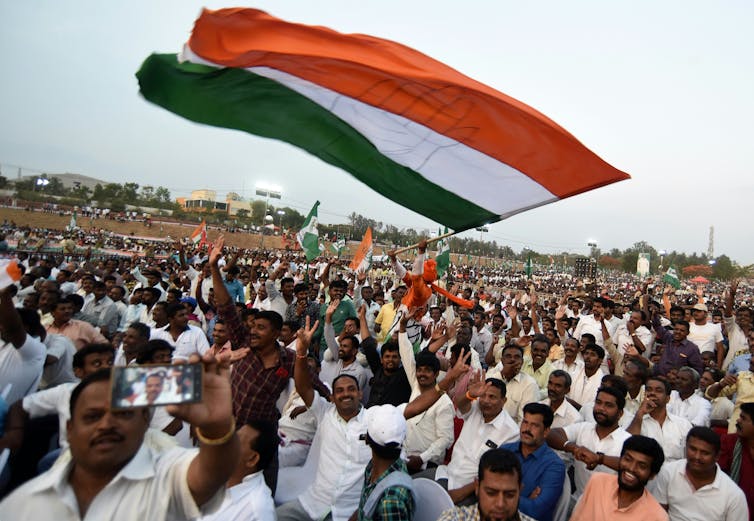
Indians are about to start voting in the world’s largest democratic exercise. The country’s 900m registered voters will vote in national elections between April 11 and May 19 across 1m polling stations in 543 constituencies. India has a Westminster-style parliamentary democracy with voters electing their representatives to India’s lower house of parliament, the Lok Sabha. Voting has been staggered over seven phasesto ensure that the electoral process is provided the necessary security. The results will be declared on May 23.
India’s current prime minister, Narendra Modi, is up for re-election as the head of the Hindu nationalist Bharatiya Janata Party (BJP) and its allies the National Democratic Alliance. A polarising figure, opinions diverge sharply over Modi’s record in government and his legacy.
Supporters insist that Modi has ushered in economic development, military strength, national pride and a sense of confidence among the country’s Hindu majority. Critics challenge such claims, pointing to soaring unemployment (the worst in 45 years), agrarian distress, reassertion of caste privilege and social polarisation.
Modi faces a range of opposition forces. The principle opposition is provided by the Congress Party and its allies, the United Progressive Alliance. Other opponents include regional parties in different states, such as Uttar Pradesh, West Bengal and Andhra Pradesh, as well as leftist parties in the state of Kerala. The BJP and its allies enjoy a crushing majority in the Lok Sabha, controlling 336 of the 543 seats: the BJP alone has 268 seats.
Fears abound that Modi’s re-election will rent asunder India’s constitutional values and social fabric. Since the BJP’s ascension to power, lynchings of social minorities, especially Dalits and Muslims, have been on the rise. Leaders of India’s historically oppressed Dalit communities remain anxious that the BJP seeks to dismantle the affirmative actions for oppressed populations guaranteed by the Indian constitution. The very idea of India is at stake.
A thriving democracy
When India became independent in 1947, few people expected the country to survive. Nevertheless, Indians introduced universal adult suffrage soon after obtaining independence and adopted a republican constitution in 1950, a full 15 years before economic superpowers such as the US lifted literacy and tax qualifications for voting.
Throughout the 1950s and 1960s international observers remained sceptical of India surviving as a democracy, given its huge levels of poverty and illiteracy. Yet, India not only survived but also emerged – warts and all – as one of the world’s most thriving democracies. The country presents a very moving story of the ways in which some of the poorest people on the planet have sought to construct and sustain democracy against enormous odds. Their achievements are under threat today.
India poignantly illustrates the global challenges posed to democracy by the rise of nationalism and populism. Identity politics, or a politics that focuses on people’s particular social identities, permeates political narratives in India as elsewhere in the world in 2019. Indians are faced with an idea of nationalism that seeks to exclude significant sections of their own population from its ambit. And they have borne the brunt of right-wing populism, as shown by the growth of cow-protection squadsadministering vigilante justice over the last few years.
Social identity provides the basis of political mobilisation. India today faces these challenges alongside countries such as Brazil, Turkey, the US and various European countries. Modi joins a galaxy of strongmen politicians such as Brazil’s Jair Bolsonaro, Turkey’s Recep Tayyip Erdoğan, the US’s Donald Trump and Hungary’s Viktor Orbán, accused of rolling back democratic achievements of the last few decades.
How Indians respond to the challenges of exclusionary nationalism, right-wing populism and supremacist identity politics in the 2019 elections holds key lessons for the world as it confronts the global backsliding of democracy. After all, elections provide a window onto the hopes harboured by citizens, the anxieties they confront and the possibilities they imagine. The narratives that emerge prior to, during, and immediately after any elections offer unique insights into ongoing processes of social change.
India Tomorrow
It is into these imaginations, narratives and social processes, rather than the machinations of the different political parties, that The Conversation will delve over the next few weeks.
In a seven part series, India Tomorrow, from The Anthill podcast, The Conversation will explore the ways in which nationalism and populism are playing out in India as the country heads to polls. We will be speaking to academics from around the world to help illuminate the topics that are not only key to the forthcoming elections but offer an insight into the social upheaval Indians are experiencing in the 21st century.